For twenty years, the deal with Google was simple. You typed something in, you got ten blue links, and your job as a business owner was to climb that list. Everybody understood the game even if they hated playing it.
That deal is changing — not because Google's index went away, but because something new got bolted on top of it. Ask ChatGPT for "a good plumber near me who can come out today" and you don't get ten links. You get a paragraph that names one or two businesses and moves on. Ask Google the same thing and an AI Overview often answers before the map pack even loads. Perplexity will hand you a tidy summary with footnotes.
None of those tools built their own map of the internet. They're reading the one that already existed. What's new is the reader — a layer that sits on top of the search index, reads everything that's stored about you, reconciles it, and decides whether you make the final cut. Understanding that one shift is the difference between businesses that stay visible and businesses that quietly disappear from answers they used to win.
Here's what we've learned helping local businesses get found, and what it actually means for yours.
What "AI search" actually is
Strip away the hype and it's straightforward. AI search is a synthesis layer that sits on top of an existing search index, reads the facts already stored about a business, reconciles the ones that disagree, and returns a single curated answer instead of a list of links. It is not a new place to rank. It is a new reader judging what's already there.
That distinction matters because of where the data lives. Google AI Overviews read Google's own organic index — the same one your website has been crawled into for years. ChatGPT's search borrows Microsoft Bing's index. Perplexity runs a fresh web search on every query. Three different readers, but they're all reading from indexes that already existed. The index is the basement. The AI layer is the new floor built on top of it.
So the real change isn't what gets stored about your business. It's who reads it — and how mercilessly the new reader judges anything that doesn't add up.
The layer model, in one picture
We find it helps to stop thinking about "AI search" as one thing and start thinking in layers.
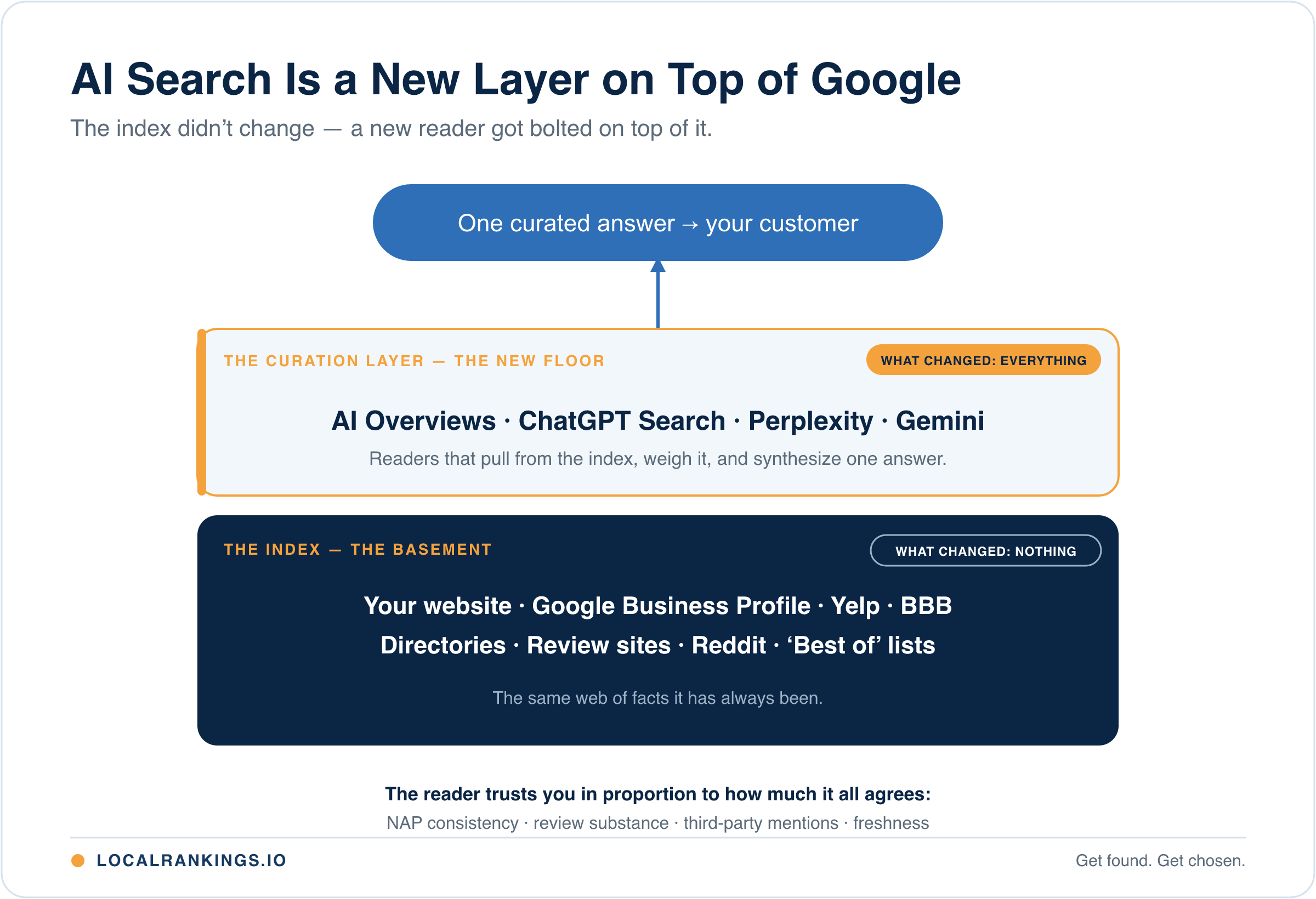
AI search is a new floor built on top of the same index that's always existed — the reader is new, the basement isn't.
| Layer | What lives here | What changed |
|---|---|---|
| The index (basement) | Your website, Google Business Profile, Yelp, BBB, directories, review sites, Reddit threads, "best of" lists — every page about you a search engine has crawled | Nothing. This is the same web of facts it's always been. |
| The curation layer (new floor) | AI Overviews, ChatGPT Search, Perplexity, Gemini — readers that pull from the index, weigh it, and synthesize one answer | Everything. This is the new thing standing between your information and the customer. |
| What the reader weighs | Cross-platform consistency of your name/address/phone, review sentiment and substance, how often credible third parties mention you, freshness of your profile | The bar moved up. Thin, stale, or contradictory information now gets you filtered out instead of buried on page two. |
The old game was vertical: climb the list. The new game is about whether the reader on the top floor trusts the facts in the basement enough to repeat them.
Three readers, three different appetites
Treating ChatGPT, Google's AI, and Perplexity as interchangeable is the most common mistake we see. They read differently, and that changes who they cite.
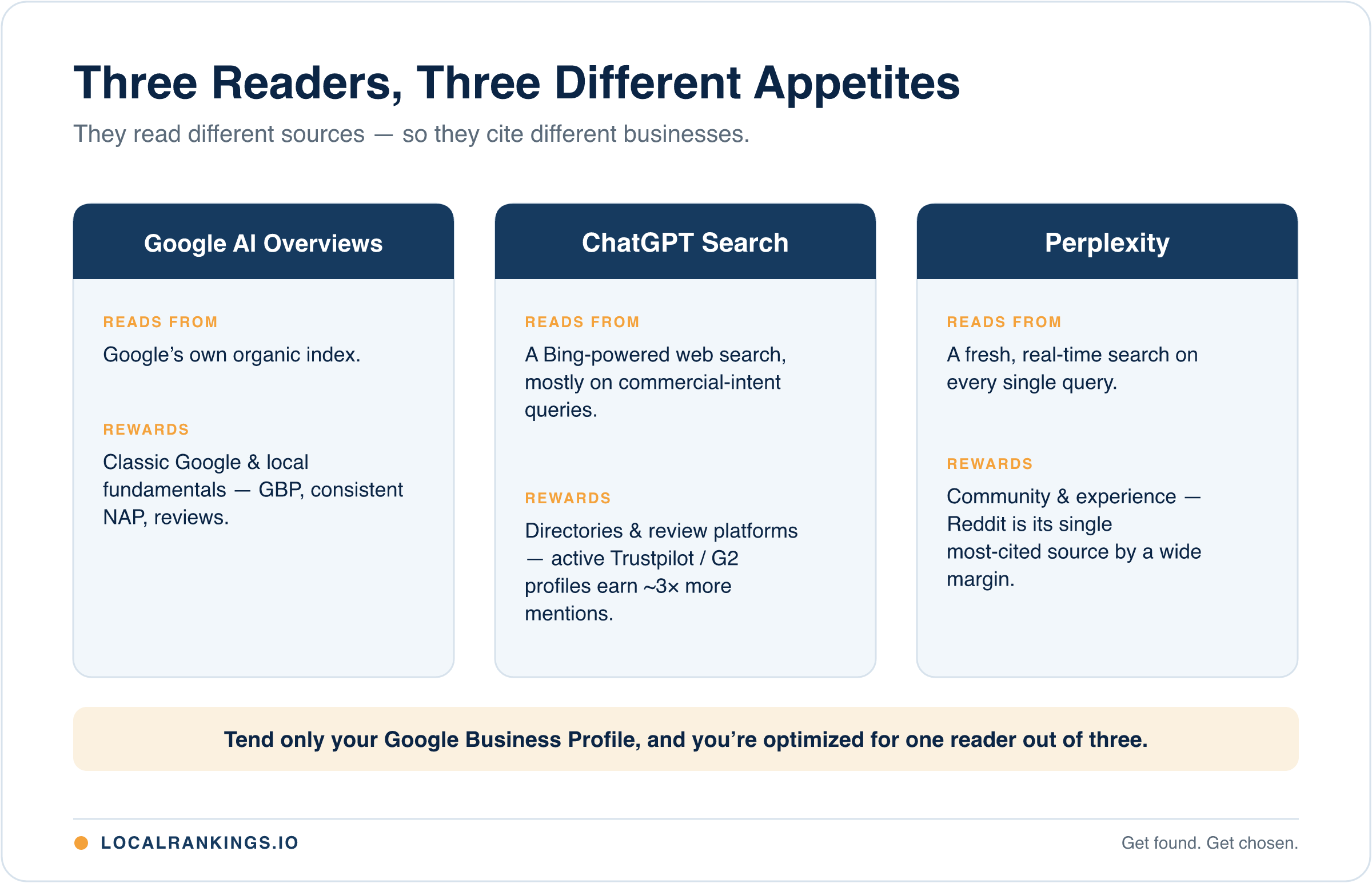
Three readers, three different appetites — a Google-only presence is optimized for just one of the three.
Google AI Overviews and AI Mode ride Google's own organic index. If your page isn't indexed by Google, it can't be cited by Google's AI — citation eligibility follows the same indexing timelines you already know. This is the engine most tied to classic local signals, because it's literally reading Google's own data.
ChatGPT Search uses its training data as a base and triggers a Bing-powered web search mostly on commercial-intent queries — the "who should I hire" and "what's the best" questions. It leans heavily on established directories and review platforms. Industry data shows brands that keep active profiles across multiple review platforms like Trustpilot and G2 are mentioned roughly three times more often. It also cites competitor and third-party sites far more than Google traditionally has.
Perplexity runs a real-time search on every single query and leans hardest on community and experience sources. According to citation analyses, Reddit is consistently Perplexity's single most-cited source, with YouTube and review sites close behind — community and experience content carries real weight.
The practical takeaway: there is no single "rank in AI" lever. The engine reading Google's index rewards your Google fundamentals. The engines reaching into Bing, Reddit, and review platforms reward a presence that lives well beyond your own website. A business that's only tended its Google Business Profile is optimized for one reader out of three. (This is also why we treat local SEO and paid search as one system rather than separate boxes — the readers pull from everywhere.)
Query fan-out: how one local question becomes nine
The mechanic underneath all of this is worth understanding, because it explains why consistency matters so much.
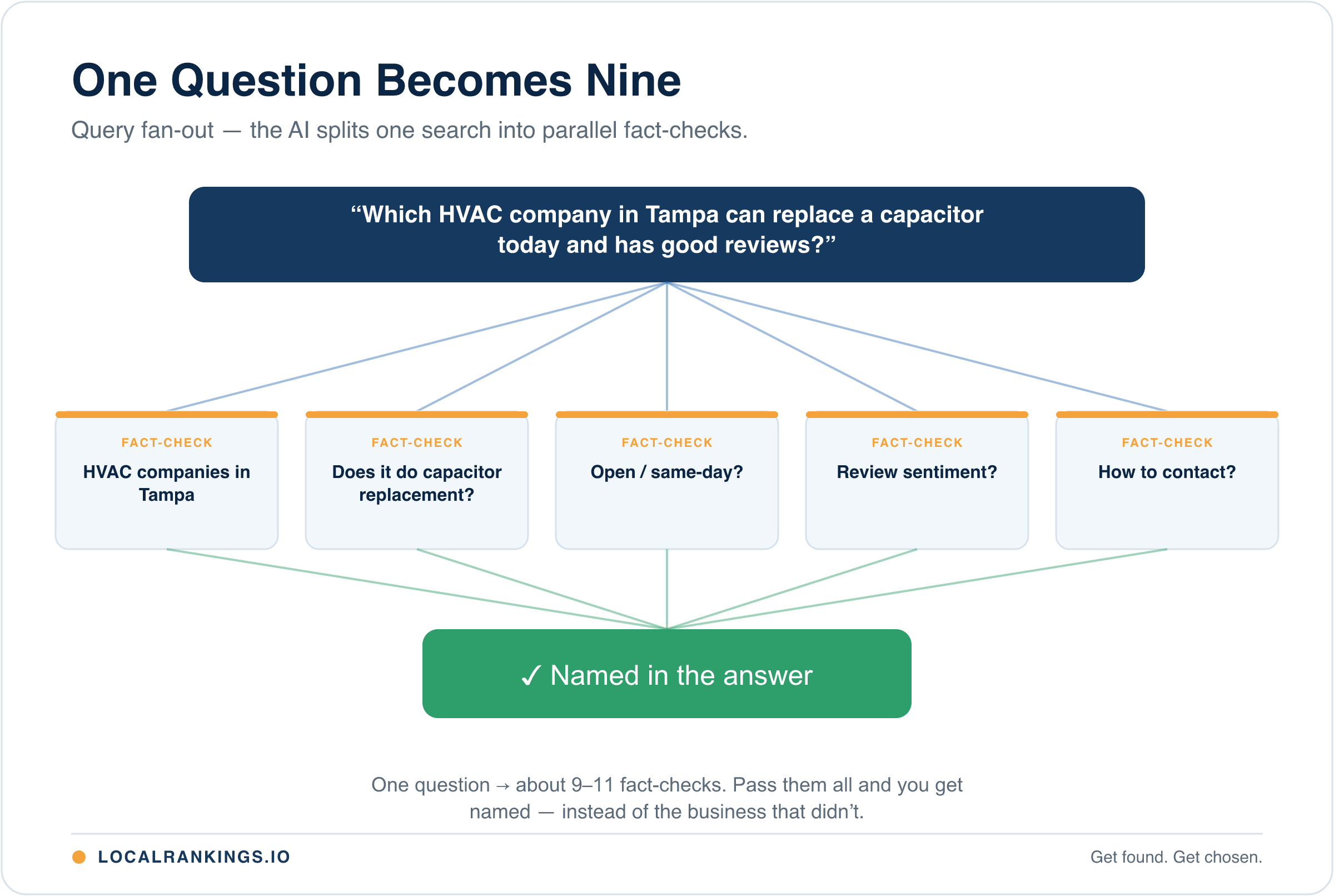
One question becomes roughly nine fact-checks. Pass them all, and you're the business that gets named.
When you ask a modern AI engine a local question, it doesn't run that one search. It quietly breaks your question into a fan of smaller ones. Google's own documentation and analyses from Search Engine Land describe this "query fan-out": a single prompt gets decomposed into several parallel sub-queries — studies put it around nine to eleven for complex local intent — before the AI assembles an answer.
So when a customer types "Which HVAC company in Tampa can replace a capacitor today and has good reviews?", the reader doesn't search that string. It fans out into something like: HVAC companies in Tampa · do they do capacitor replacement · are they open / same-day availability · what's their review sentiment · how do I contact them. Then it cross-checks the answers and names whoever survives all five.
That's the whole story in one example. Every sub-query is a fact-check. If your hours are wrong on one directory, your phone number disagrees between Yelp and Google, or your reviews are thin, you fail one of the checks — and a business that passes all of them gets named instead of you.
The number nobody will give you straight
Now for the honest part, because this is where most articles on this topic quietly mislead you.
If you go looking for "how often does AI actually show up in local search," you'll find confident, contradictory numbers. Some sources say AI Overviews appear on as few as 7–8% of local searches. Others claim 68%. Studies of overall AI Overview prevalence range from Conductor's ~25% to BrightEdge's ~48%. Every agency seems to pick the number that fits whatever it's selling.
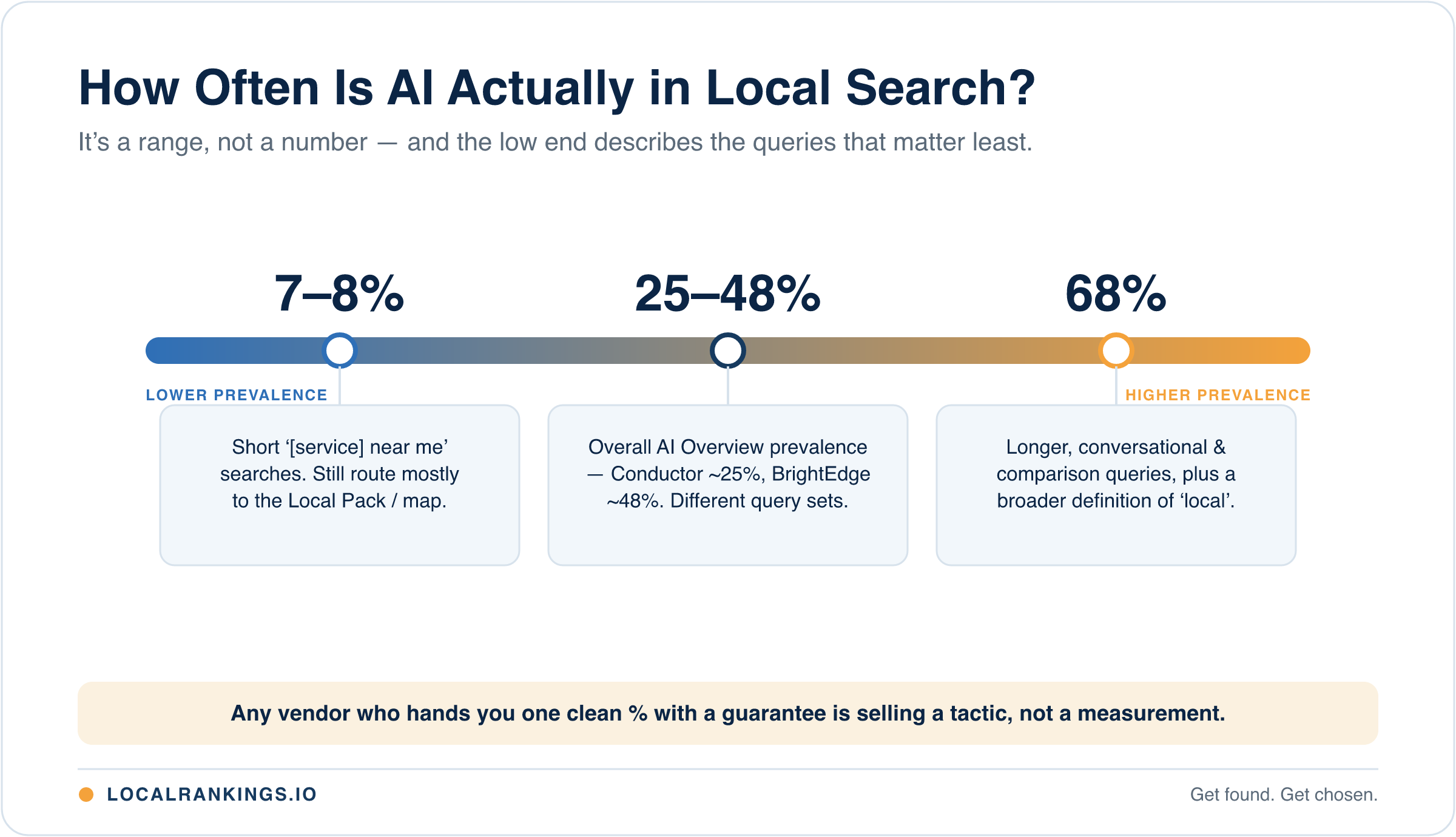
It's a range, not a single number — and the low end describes the lowest-stakes searches.
Here's what's actually going on, and why we won't hand you a single figure and pretend it's settled:
| The claim | The likely truth |
|---|---|
| "AI appears on only 7–8% of local searches" | True for short "[service] near me" queries — those still route mostly to the classic Local Pack / map results. |
| "AI appears on 68% of local searches" | Reflects longer, conversational, comparison-style queries ("best…", "who should I call for…", "which company can…") plus a more generous definition of "local." |
| "AI Overviews appear on 25% / 48% of all searches" | Both are real — they used different query sets and industries. The honest answer is a range, not a number. |
The truth is a moving target that depends on how someone defines "local" and "AI." But don't let the low end fool you into ignoring this: the small percentage describes the short, low-stakes "near me" searches — the queries that matter least to whether someone actually hires you. The conversational, multi-part questions are where AI is taking over fastest, and they're also the highest-intent ones. Nobody types "which company can fix my burst pipe today and has good reviews" unless they're ready to call someone. Those queries are growing, and they're exactly where the AI reader decides who gets mentioned and who doesn't.
If a vendor gives you one clean percentage and a guarantee built on it, that's a sales tactic, not a measurement. The leak you actually need to fix doesn't depend on which study is right.
The curation layer is a consensus engine
This is the thing almost nobody says plainly, and it's the part that matters most.
The AI reader on the top floor is not a ranking machine. It's a consensus engine. It reads what your website says, what Google says, what Yelp says, what the "best plumbers in town" list says, what your reviews say — and it trusts you in proportion to how much all of that agrees. Disagreement reads as risk. A phone number that's different in two places, hours that contradict, a name spelled three ways, a profile that hasn't moved in a year — every one of those is a small reason for the reader to name someone else instead.
We've said for years that missed calls are a marketing problem disguised as a phone problem: you spend on getting found, then leak the leads at the last step. AI search is the same logic moved upstream. You can pour money into "ranking for AI," but if the basement is full of contradictions, the reader on the top floor won't repeat you. You can't be curated if you're not consistent. Fix the leak before you fill the bucket.
That reframes the whole job. The lever isn't a clever new tactic. It's making every source the reader checks tell the same story — accurate, current, and backed by enough credible third-party mentions and substantive reviews that your version of the facts is the obvious one to repeat.
What this does NOT change
It would be easy to read all of this as "everything you know is obsolete." It isn't, and anyone telling you SEO is dead is selling you the cure.
The foundations didn't move. A complete, accurate, regularly updated Google Business Profile still does the heaviest lifting — it's the single strongest local signal, and it feeds the AI layer directly. Reviews still matter, citations still matter, consistent name-address-phone across the web still matters. The Whitespark 2026 local search ranking factors survey — the closest thing the industry has to a canonical source — still puts these fundamentals at the center — its top AI-visibility factors are the same ones you've heard about for years: on-page service pages, reviews, and citations.
What changed is the penalty. The old web buried a stale or inconsistent profile somewhere on page two, where a determined customer might still scroll to it. The new reader just leaves you out of the answer entirely. Mediocrity used to scrape into position three; now it gets filtered before the answer is written. The work is the same work. The cost of skipping it went up.
What this means for your business this quarter
You don't need an "AI strategy." You need the basement clean enough that the reader on the top floor trusts it. In order:
Make your facts agree everywhere. Audit your name, address, phone, hours, and services across Google, Yelp, Bing, Facebook, and the directories that matter for your trade. One contradiction is one reason to be skipped. This is the cheapest, highest-leverage fix there is, and it's exactly the kind of thing our local SEO work starts with.
Treat your Google Business Profile as live, not a billboard. Fill every field, post regularly, keep photos fresh, and respond to reviews. A profile that hasn't changed in a year reads as a business that might not be open.
Earn mentions you don't own. The heaviest AI levers are third-party: "best of" lists, local press, industry directories, substantive reviews. Analysis from the AI-visibility tracker ZipTie found that the substance of a review correlates far more strongly with AI visibility than the raw count, and that roughly 80% of the sources AI cites for local answers don't even appear in Google's top 100 organic results. Being good on your own site isn't enough; you have to show up where the consensus is being built.
Write for the question, not the keyword. The queries AI handles are conversational and specific. Pages that plainly answer "who should I call for emergency AC repair near me tonight" — in clear, structured language — are the ones the reader can lift and cite. (We write more about this kind of thing on the LocalRankings blog.)
Measure what actually moves. Track whether you're getting named in AI answers and where your customers actually come from, not just where you rank. A page that doesn't bring in customers isn't a win, no matter what an AI mentions. (If you're not sure where you stand, a quick audit will tell you.)
The bottom line
AI search isn't a new place to rank. It's a new reader sitting on top of the index that's always existed — one that rewards businesses whose story is consistent everywhere and quietly drops the ones whose story doesn't add up. The fundamentals you've been told to care about didn't change. The reader just stopped being patient about them.
That's good news if you've done the unglamorous work, and a warning if you haven't. Either way, the fix is the same one it's always been: get found, then stop leaking. We help local businesses do exactly that — if you want to know where your business actually stands with the new reader, let's talk.